
China Top 10 Portable EV Charger Manufacturers?

Portable EV chargers are becoming practical tools for drivers who need flexible charging at home, at work, or on the road. China has a broad manufacturing base, but products can differ sharply in power output, connector options, build quality, and after-sales support. A familiar-looking cable does not tell the whole story. Details matter.

This guide introduces ten Chinese manufacturers associated with portable EV charging equipment. It considers useful buyer criteria, including rated current, input requirements, temperature protection, enclosure durability, warranty terms, and the clarity of product documentation. These details help distinguish a dependable unit from one that merely looks competitive in a product photo. A Portable Ev Station may suit one driver’s routine and fail another’s needs. Check the vehicle’s charging limits and the available power supply before comparing models.

The list should be treated as a starting point, not a universal verdict. Manufacturer claims and available configurations can change, while certification and connector requirements vary by destination. Buyers should verify current specifications directly with suppliers and request supporting documents where appropriate. A low price can be attractive. It is not the entire calculation. Real-world support, replacement parts, and clear operating instructions matter too. Some information may remain difficult to compare across brands; that uncertainty deserves attention rather than a confident guess. The following overview aims to make the comparison more grounded and help readers ask better questions before choosing a charger.
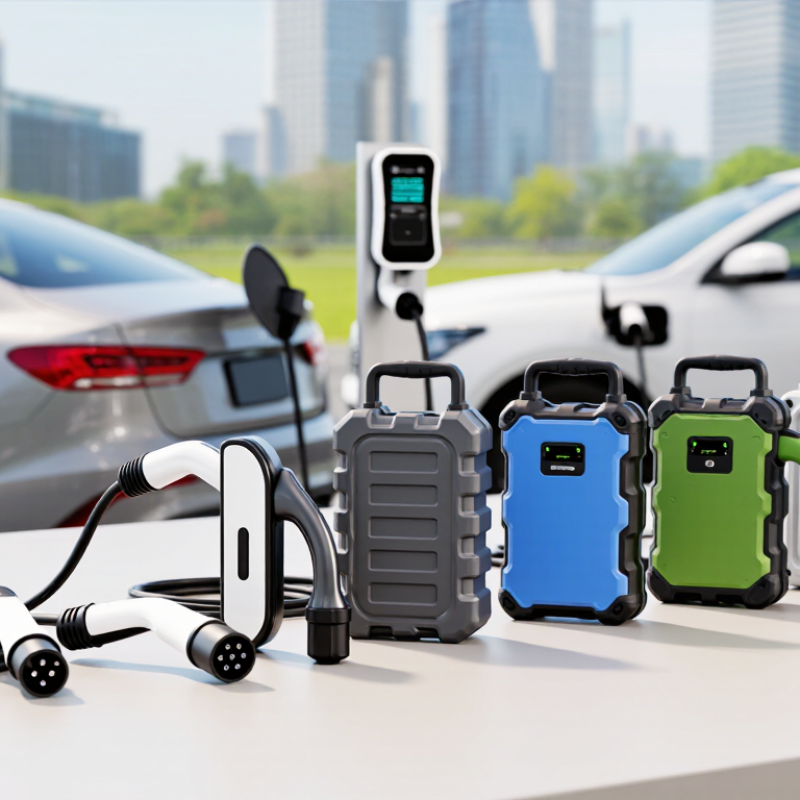
China Top 10 Portable EV Charger Manufacturers?

What Portable EV Chargers Are and How They Work

A portable EV charger is a compact charging cable and control unit that connects an electric vehicle to a suitable power outlet. The name can be misleading: the unit usually does not convert household electricity into battery-ready direct current. Instead, it safely supplies alternating current, which the vehicle’s onboard charger converts. A small control box along the cable monitors the connection and can stop power if it detects a fault. Simple, but useful.

Charging begins when the plug, control unit, and vehicle communicate. The system checks conditions such as grounding and acceptable current before electricity flows. Charging speed depends on the outlet’s voltage and current, the cable’s capacity, and the vehicle’s onboard charger. A regular household socket may add only a modest amount of range overnight. That can be enough for daily driving, though it may feel slow after a long trip.

Portability is the main advantage. The cable can stay in a vehicle for travel, workplace charging, or emergencies. Still, not every outlet is suitable. A loose socket or overloaded circuit can create heat, so users should follow the charger and vehicle instructions and avoid extension cords unless explicitly permitted. I would not treat “portable” as “works anywhere.” Outlet quality varies, and checking it beforehand is easy to overlook.

China’s Portable EV Charger Industry at a Glance

China’s portable EV charger industry brings together electronics manufacturing, cable production, power-control engineering, and testing services. Many suppliers can adapt cable length, plug type, display, and packaging for different markets. Behind a compact charging unit are less visible details: heat management, enclosure strength, and stable current control. Small details matter.

A typical production line may include circuit-board assembly, firmware checks, enclosure fitting, and final electrical testing. Buyers should review rated output, supported connectors, safety protections, warranty terms, and test documentation—not just the product photos. A charger that feels sturdy in the hand still needs consistent performance under repeated use. That distinction is easy to miss.

Manufacturing capacity can be strong, but supplier capability is not uniform. Some firms focus on volume, while others offer more customization or closer engineering support. Specifications and quality records should be verified for each model and destination market. Even a clear datasheet may leave practical questions unanswered, such as how a unit handles a warm garage or a tightly coiled cable. The industry is evolving, and careful comparison remains worthwhile.

Criteria for Evaluating Chinese Charger Manufacturers

When comparing Chinese portable EV charger manufacturers, evaluate the product, factory controls, and evidence behind each claim. The IEA’s Global EV Outlook 2024 reports that China sold over 8 million electric cars in 2023, nearly 60% of global sales. Scale is not proof. A large market does not guarantee consistent charger quality.

Check that test documents identify the exact model and support relevant safety requirements, such as IEC 62752 for Mode 2 in-cable control and protection devices, where applicable. Ask about overcurrent, leakage, over-temperature, and grounding protection. Verify connector options, rated current, and compatibility with the vehicle and supply. The National Energy Administration reported 12.82 million charging facilities in China by the end of 2024; this infrastructure figure describes market growth, not portable-charger test performance.

Assess durability through documented heat, cable-flex, drop, and water-resistance tests. Request serial-numbered inspection records and evidence that production samples match tested units. Ask how warranty claims are tracked and what response times apply. One clean sample can still hide batch variation. I would not reject a supplier over one isolated defect, but repeated faults deserve a hard look. A polished certificate is useful; traceable, model-specific records are better.

Profiles of Ten Leading Portable EV Charger Manufacturers

Profiles of ten leading Chinese portable EV charger manufacturers should compare engineering evidence, not glossy product images. The International Energy Agency’s Global EV Outlook 2024 reports nearly 14 million electric car sales worldwide in 2023, about 18% of new car sales. That growth makes dependable charging equipment more important, including portable units used at home, workplaces, and overnight stops. Still, market growth alone does not prove a supplier’s quality.

A useful profile checks input voltage, adjustable current, connector options, cable length, enclosure protection, thermal safeguards, and traceable test documentation. It also asks whether the manufacturer controls assembly and can explain inspection procedures. Small details matter. A bulky control box may be awkward beside a narrow parking space. Profiles should distinguish basic emergency charging from regular daily use, without treating every portable unit as interchangeable. The IEA also recorded roughly 40% growth in public charging points during 2023, but that figure does not measure portable-charger demand. Worth noting. Buyers should request product-specific evidence rather than infer performance from broad market statistics. Some supplier information can be thin; that deserves scrutiny, not an automatic rejection.

China Portable EV Charger Manufacturers: Technical Overview

Portable AC EV chargers are available in different voltage and current configurations. The power values shown are calculated as nominal voltage multiplied by current; they are technical examples, not company rankings or market-share figures. Actual charging speed depends on the vehicle’s onboard charger and electrical supply.

Comparing Product Features, Certifications, and Market Reach

Comparing portable EV charger manufacturers takes more than reading headline power ratings. Check adjustable current settings, connector compatibility, cable length, and protection against overheating or water and dust. A cable that reaches a driveway outlet comfortably can matter more than a small difference in charging speed. Ask whether the stated output reflects continuous use or ideal test conditions. The distinction is easy to miss.

Certifications should be checked against the destination market and the exact product model, not just a company’s general claims. Request current test documents and confirm that labels match the unit being quoted. Market reach also deserves careful scrutiny. Look for local service contacts, spare-part availability, clear manuals, and support response times in the regions where the charger will be sold. A wide export footprint sounds reassuring. It is not proof of dependable after-sales care.

Import records and distributor lists may be incomplete, so treat them as clues rather than rankings. A comparison table can look precise while hiding uneven evidence. That deserves a second look. For a fair shortlist, compare the same features across manufacturers and note which details remain unverified.

We are crowdfunding!
Privacy Overview

This website uses cookies so that we can provide you with the best user experience possible. Cookie information is stored in your browser and performs functions such as recognising you when you return to our website and helping our team to understand which sections of the website you find most interesting and useful.

Find out more about Kitepower's privacy policy