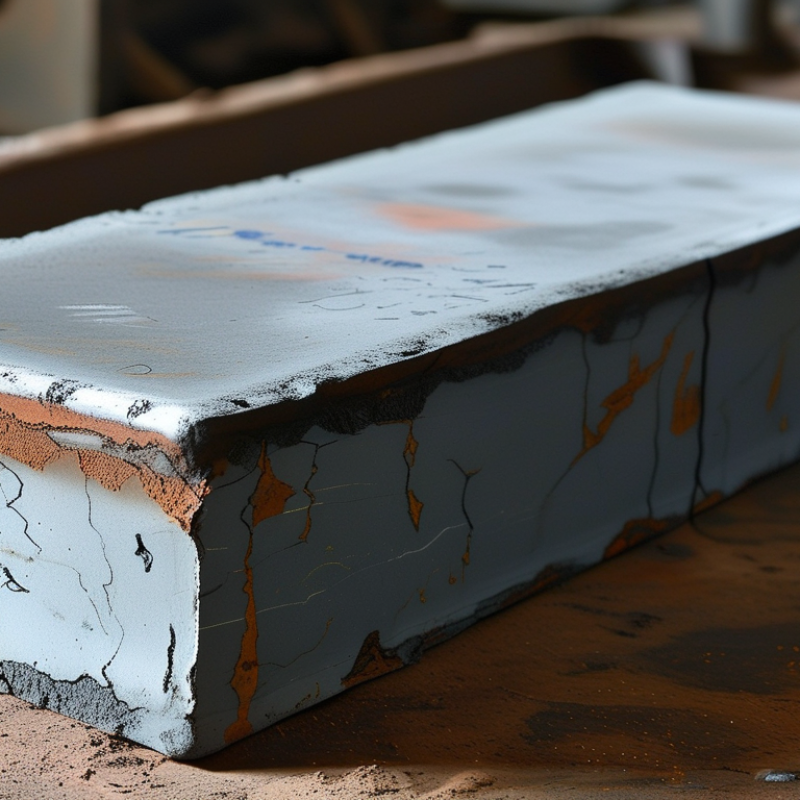
Choosing the right Anode Carbon Block is not a simple purchasing decision. It affects current efficiency, carbon consumption, cell stability, and the amount of residue left in the pot. Dr. T. R. Tabereaux puts it plainly: “Anode quality is a major factor in cell performance.” His view reflects practical smelter experience, where small material differences can become visible during daily operation.
A reliable selection begins with measurable properties. Check apparent density, electrical resistivity, compressive strength, thermal conductivity, and air reactivity. These figures should be reviewed beside the anode’s working conditions, not studied in isolation. A dense block may resist penetration better, yet excessive density can complicate thermal behavior. It is not always better.
Look closely at the details. Examine cracks around the stub holes. Review the baking temperature curve. Compare the supplier’s laboratory data with performance records from similar reduction cells. An anode that survives transport can still develop edge cracking after installation. That matters. Butt consumption, dusting, and sodium expansion also deserve attention.
There is no universal best Anode Carbon Block. Pot design, alumina concentration, current load, and operating discipline change the answer. I would not choose from a spreadsheet alone. A short plant trial often reveals weaknesses that certificates hide. The process may feel less elegant, but it is more honest. Ask suppliers for traceable test methods, consistent batches, and evidence from comparable smelters. Then balance price against stable performance, because the cheapest block can become expensive inside the cell.
How to Choose the Right Anode Carbon Block?
Understanding the Role of Anode Carbon Blocks in Aluminum Production
Anode carbon blocks are essential consumable electrodes in the Hall-Héroult process. They carry electric current into the alumina bath. The carbon reacts with oxygen and gradually becomes carbon dioxide. This reaction supports aluminum production, but it also consumes the anode.
A suitable block must balance electrical conductivity, mechanical strength, density, and resistance to thermal shock. Low electrical resistance can reduce energy loss. Strong blocks are less likely to crack during baking, transport, or cell operation. Small pores matter too. Excessive porosity may increase air and electrolyte penetration. That can raise carbon consumption and disturb cell stability. In practice, uneven wear often reveals problems that laboratory figures miss. The selection is not perfect.
Operators should examine raw material quality, forming pressure, baking conditions, and machining accuracy. Dimensional consistency helps maintain stable spacing between the anode and cathode. A poorly fitted block may create uneven current distribution. It can also produce local heat and unwanted sludge. Reliable evaluation requires test data, production records, and regular inspection of used anodes.
Tips: Check apparent density, resistivity, flexural strength, and thermal expansion. Compare results across several batches. Inspect cracks around holes and edges. Do not judge quality from appearance alone. A darker surface proves little. Review performance inside the reduction cell, where real conditions can challenge every specification.
Understanding the Role of Anode Carbon Blocks in Aluminum Production
This chart illustrates the typical relationship between aluminum cell current efficiency and net carbon consumption. High-quality prebaked anodes with suitable apparent density, low electrical resistivity, adequate mechanical strength, and controlled air and CO₂ reactivity can help reduce excess carbon consumption and support stable cell operation. Values are representative engineering benchmarks; actual performance depends on cell design, operating conditions, and anode quality.
Choosing an anode carbon block starts with defining the potroom’s real operating conditions. Electrical resistivity, apparent density, strength, and reactivity should be assessed together. A low-resistivity block can still perform poorly if it cracks during thermal cycling.
Industry benchmarks commonly place net anode consumption near 400–450 kilograms per tonne of aluminium. This figure varies with current efficiency, anode effects, and operating practice. The International Aluminium Institute’s production data shows the scale of primary aluminium production worldwide, making small anode losses financially significant. In a high-current cell, even minor carbon oxidation can increase replacement frequency and energy demand.
Test the details.
Ask suppliers for results from recognized methods, including ISO 12981-1 for carbon dioxide reactivity and relevant standards for density and electrical resistance. CO2 and air reactivity deserve close attention because they indicate how quickly the block may be consumed near the bath and sidewall regions. Thermal shock resistance also matters. A block that passes room-temperature strength testing may still fail after rapid heating.
Specification sheets often hide variation between batches. That is a weakness. Require sampling plans, traceability, and independent verification when performance is critical. Review butt quality, crack history, and machining behavior with experienced operators. These practical observations can reveal problems that laboratory averages miss. I would not select the densest block automatically; excessive density may reflect a compromise in impregnation or thermal response. The right choice is the block that maintains stable resistance, limited reactivity, and structural integrity throughout its service life.
Choosing the right anode carbon block begins with its raw materials. Calcined petroleum coke provides the carbon skeleton, while coal-tar pitch binds the particles during forming. Examine particle size, ash content, sulfur, moisture, and trace metals. Consistent raw materials usually produce steadier electrical resistance and lower consumption. Recycled carbon may reduce waste, but its chemistry must be controlled carefully. Cheap feedstock can become expensive later.
Manufacturing details matter just as much. Crushing, screening, mixing, kneading, vibration forming, and baking must follow controlled procedures. Baking temperature and heating rates affect porosity, strength, and volatile release. Ask for batch records, not only polished product photos. I would not trust one laboratory result alone. Test data should cover apparent density, compressive strength, electrical resistivity, air permeability, and CO2 reactivity. Dimensions and surface condition also deserve inspection because small cracks can expand during operation. Relevant ISO or ASTM methods may support testing, but the agreed technical specification remains essential.
Tips: Request a recent certificate of analysis and an independent test report. Compare samples from several production batches. Check whether the supplier explains deviations honestly. A reliable producer should identify limits, corrective actions, and storage requirements without vague promises. Calibration records help, too. Keep the questions specific.
| Category | Selection Dimension | Typical Industry Data or Target Range | Effect on Anode Performance | Recommended Quality Verification |
|---|---|---|---|---|
| Raw Material | Calcined petroleum coke | Fixed carbon commonly ≥98.5%; ash generally ≤0.5%; moisture after calcination is normally controlled at a low level. Particle-size distribution is adjusted for the block recipe. | Provides the main carbon skeleton. Low ash and stable granulometry improve electrical conductivity, density, and resistance to chemical attack. | Check proximate analysis, sulfur, vanadium, nickel, ash, moisture, true density, and particle-size distribution. |
| Raw Material | Coal-tar pitch binder | Binder softening point is commonly about 100–115°C, although the selected grade depends on mixing, forming, and baking conditions. Quinoline-insoluble content is often specified within a controlled range. | Controls green strength, binder distribution, pore formation, baking shrinkage, and final mechanical properties. | Measure softening point, coking value, quinoline insolubles, toluene insolubles, moisture, viscosity, and ash. |
| Raw Material | Anthracite or other low-volatile carbon additions | May be used in selected formulations. Typical anthracite feedstocks contain approximately 85–90% fixed carbon, with ash depending strongly on the source and beneficiation process. | Can improve resistance to oxidation and alter shrinkage, but excessive ash or mineral matter can increase electrical resistivity and reduce purity. | Verify fixed carbon, volatile matter, ash, sulfur, moisture, and mineral composition before approving the material. |
| Raw Material | Recycled anode butts | Often recycled after cleaning and crushing. The usable proportion depends on residual electrolyte, bath contamination, metal content, and particle-size control. | Reduces raw-material consumption, but contamination can increase sodium, calcium, fluoride, or other unwanted impurities. | Test sodium, calcium, fluoride, aluminum, iron, ash, moisture, and contamination from attached bath material. |
| Manufacturing | Crushing, screening, and particle grading | A multi-size aggregate system is normally used, combining coarse, medium, and fine fractions. The exact grading is recipe-specific and should be maintained within tight control limits. | Optimized grading improves packing density, reduces excess binder demand, and limits open porosity. | Use sieve analysis, material-balance checks, and routine monitoring of fines and coarse fractions. |
| Manufacturing | Heating and dry mixing | Dry aggregate is commonly heated to approximately 140–180°C before binder addition, depending on pitch properties and plant equipment. | Maintains suitable pitch viscosity and promotes uniform coating of coke particles. | Record aggregate temperature, pitch temperature, mixing time, torque, and batch discharge temperature. |
| Manufacturing | Paste mixing | Mixing time is typically controlled in the range of several minutes to approximately 20 minutes, depending on batch size, mixer design, and formulation. | Insufficient mixing causes binder-rich and binder-poor areas; excessive mixing may alter temperature and workability. | Check paste homogeneity, temperature uniformity, workability, and binder content by batch. |
| Manufacturing | Block forming | Vibrocompaction or equivalent forming methods are used. Forming pressure, vibration, filling sequence, and green density must be controlled for each block geometry. | Uniform compaction reduces internal voids, cracking, density variation, and localized high resistivity. | Measure green density, dimensional tolerances, mass variation, surface defects, and internal homogeneity. |
| Manufacturing | Baking | Industrial baking commonly reaches approximately 1,100–1,200°C, with a controlled heating and cooling cycle that may last several days. | Converts pitch into carbon, develops final strength, and determines pore structure, electrical resistivity, and reactivity. | Review furnace temperature profiles, soaking time, heating rate, cooling rate, and traceability by furnace position. |
| Manufacturing | Post-baking machining and cleaning | Machining should maintain specified dimensions, contact-face flatness, hole geometry, and surface cleanliness. | Accurate geometry supports reliable rodding, stable electrical contact, and predictable positioning in the electrolytic cell. | Use dimensional inspection, flatness checks, hole-position checks, visual inspection, and foreign-material control. |
| Finished Anode | Apparent density | A commonly encountered range for baked anodes is approximately 1.50–1.65 g/cm³, depending on formulation and production route. | Higher uniform density generally improves mechanical strength and reduces air and CO₂ penetration. | Determine apparent density using a validated laboratory method; test multiple locations or representative samples. |
| Finished Anode | Electrical resistivity | Many prebaked anode specifications target a value at or below approximately 55 μΩ·m at the specified test temperature. | Lower resistivity reduces voltage drop and electrical energy consumption during electrolysis. | Measure according to the purchaser's approved electrical-resistivity method, with controlled sample dimensions and temperature. |
| Finished Anode | Compressive strength | Typical specification levels are commonly above 30 MPa, with the actual limit determined by block design and handling requirements. | Indicates resistance to crushing during rodding, transport, installation, and cell operation. | Perform compressive-strength testing on representative baked samples and report failure mode. |
| Finished Anode | Flexural strength | Values of approximately 8–12 MPa are commonly encountered for sound baked anodes, subject to recipe and test method. | Helps assess resistance to bending, thermal stress, handling damage, and cracking. | Use a consistent three-point or four-point bending procedure and monitor variation between samples. |
| Finished Anode | Open porosity and permeability | Open porosity is often controlled within roughly 20–30%, while permeability should remain low and uniform throughout the block. | Excessive porosity increases bath penetration, air oxidation, CO₂ consumption, and carbon loss. | Check porosity, apparent density, gas permeability, and internal defects using validated laboratory methods. |
| Finished Anode | CO₂ and air reactivity | Acceptance limits vary by smelter and test temperature. Lower mass loss and lower dusting are preferred; values must be compared only under the same test conditions. | Low reactivity reduces anode consumption, dust generation, process instability, and greenhouse-gas-related carbon loss. | Use standardized CO₂-reactivity and air-reactivity tests, recording temperature, exposure time, mass loss, and dusting. |
| Finished Anode | Impurity control | Sulfur, vanadium, nickel, sodium, calcium, iron, silicon, fluoride, and other contaminants are controlled according to the smelter's process limits. | Impurities can affect anode consumption, bath chemistry, metal purity, emissions, electrical performance, and refractory condition. | Use representative sampling and laboratory analysis by validated elemental or chemical methods. |
| Quality Standards | Sampling and traceability | Each production lot should be traceable to raw-material batches, mixing records, forming conditions, furnace position, machining records, and test results. | Enables root-cause analysis and prevents nonconforming blocks from entering cell operation. | Apply a documented sampling plan, lot definition, retention-sample policy, and nonconformance procedure. |
| Quality Standards | Applicable test frameworks | Commonly referenced frameworks include ISO or ASTM methods for coke analysis, ash, sulfur, density, electrical resistivity, flexural strength, compressive strength, CO₂ reactivity, and air reactivity. | Standardized methods make supplier comparisons meaningful and reduce disagreement caused by different test conditions. | Specify the exact method, specimen preparation, test temperature, calculation formula, laboratory calibration, and reporting format. |
| Decision Rule | Choosing the right anode carbon block | Prioritize consistent raw materials, stable particle grading, uniform density, low resistivity, adequate mechanical strength, low reactivity, controlled impurities, and complete traceability. | The best selection is not based on one property alone; it must balance energy efficiency, carbon consumption, mechanical reliability, and operating conditions. | Compare suppliers using the same approved test methods, identical sampling rules, historical process data, and an agreed acceptance specification. |

Choosing an anode carbon block starts with the operating window, not a catalogue number. Current density, bath temperature, alumina feeding, and anode-to-cathode distance shape its real workload. These conditions determine the required electrical resistivity, apparent density, permeability, and mechanical strength. A high-current cell may need a denser block with stable conductivity. A poorly matched design can increase voltage drop and carbon consumption. Thermal shock matters too.
Review the block’s dimensions against the cell’s available space and lifting system. Uneven spacing can create local current concentration and irregular wear. Check the anode’s chemical composition, trace impurities, and baking quality before approval. These details influence gas generation, cracking risk, and bath cleanliness. Small cracks become costly. Operating data should guide the specification.
Plant experience shows that laboratory results do not always predict cell performance. A block with excellent test values may still react poorly to rapid temperature changes. I have seen evaluations overlook handling damage before installation. That mistake weakens even a well-made anode. Record voltage behavior, surface condition, wear profile, and carbon dust during operation. Compare those findings with supplier test data and internal acceptance limits. Leave room for review. The best specification may need adjustment after the first operating cycle.
Choosing an anode carbon block requires more than comparing quoted prices. A reliable supplier should provide production records, raw material details, and consistent quality data. Ask about baking temperature, forming pressure, and density control. These details often reveal process discipline. Inspect sample blocks for cracks, uneven surfaces, and chipped edges. Small defects can become serious during transport or operation.
Testing results should match the conditions of your plant. Review electrical resistivity, compressive strength, thermal conductivity, and air permeability. Ask whether tests followed recognized methods and whether samples came from regular production. A polished laboratory report means little without traceable sampling. Compare several batches, not one impressive result. No test is perfect.
Cost analysis should include machining, freight, storage, and possible replacement losses. A cheaper block may demand more frequent adjustments or create unstable performance. Request a trial order before signing a long contract. Track dimensions, consumption, current efficiency, and visible wear during use. Long-term reliability also depends on technical support and response time. A supplier that answers clearly during problems deserves attention. Field feedback can still be incomplete, so keep questioning your assumptions. A spreadsheet may look convincing, yet actual plant behavior remains decisive.