What Is the Best Lithium Battery Inverter in China? The answer depends on how and where the system will be used. A home backup setup has different needs from an off-grid cabin or a commercial solar installation. The right Lithium Battery Inverter should work reliably with the battery, solar equipment, and electrical loads—not just look impressive on a product sheet. There is no single winner for every buyer.
This guide compares the details that matter in real installations: continuous output, surge capacity, battery voltage, charging options, efficiency, and monitoring features. It also considers how clearly manufacturers explain compatibility and provide technical support. For example, a refrigerator may need extra power when its compressor starts, even if its normal running demand is modest. Small details like that can change which inverter suits a system.
Chinese manufacturers offer a wide range of models, but specifications and support can vary. Check current product documents, warranty terms, and applicable local requirements before choosing. A datasheet cannot tell you everything. Installation quality, temperature, cable sizing, and battery settings also affect performance. I would be cautious about any ranking that names one model as the best without stating its test conditions. Some comparisons are imperfect, and product information may change. The sections ahead explain how to compare options fairly, identify practical trade-offs, and choose an inverter that fits your battery and daily energy needs.
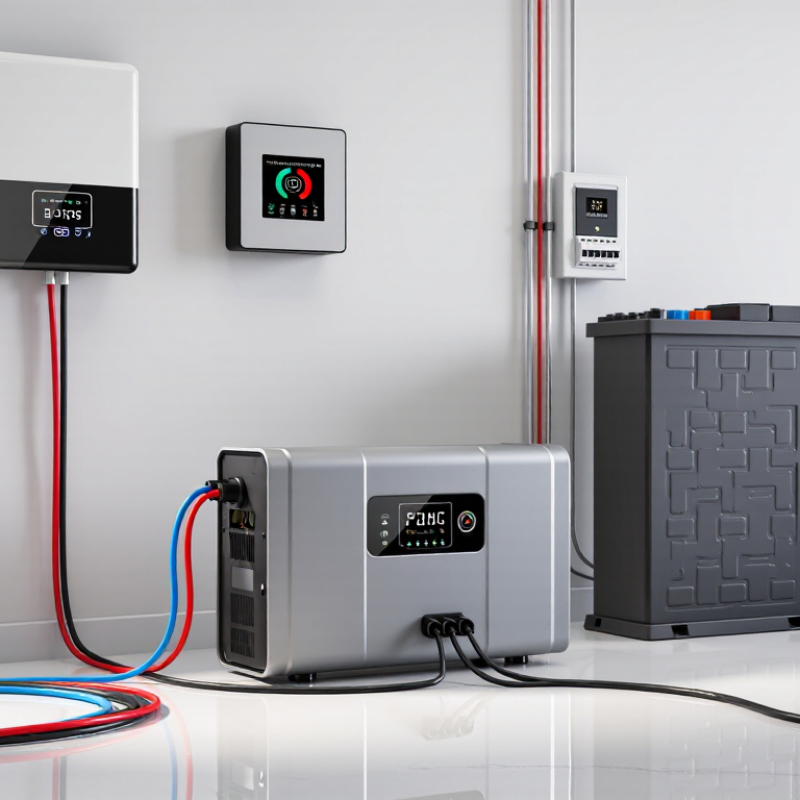
A lithium battery inverter manages the two-way flow of electricity between a battery and household circuits. The battery stores direct current (DC); most appliances use alternating current (AC). During discharge, the inverter converts DC into AC. During charging, it converts incoming AC back to DC. A hybrid model can also coordinate solar panels, the battery, and the grid.
Its controls matter as much as conversion. The inverter checks battery voltage and temperature, then communicates with the battery management system to limit charging or output when needed. It can also switch to backup power during an outage, if the system is designed for that function. The handoff may take a moment. That detail is easy to miss when comparing specifications.
Efficiency figures need context. NREL’s 2024 Annual Technology Baseline uses about 85% round-trip efficiency for utility-scale battery storage systems; this includes more than the inverter alone. The International Energy Agency reported roughly 42 GW of battery storage additions in 2023, showing how quickly these systems are expanding. For a China-market installation, check battery-inverter compatibility, supported voltage, continuous output, and backup switching time. A high headline efficiency cannot fix a mismatched system.
Choosing the best lithium battery inverter in China starts with fit, not a headline efficiency figure. Check battery voltage, usable capacity, and continuous output against real household loads. A refrigerator may draw a sharp starting surge; a pump can do the same. Surge rating and duration matter. Confirm that the inverter and battery communicate through supported CAN or RS-485 protocols, and verify charge-current limits in writing. Compatibility is not automatic.
NREL’s 2024 Annual Technology Baseline uses about 85% round-trip efficiency for utility-scale lithium-ion storage. That is a system benchmark, not a household inverter guarantee. Compare tested efficiency across typical loads, not only peak efficiency. Also inspect operating temperature, cooling, overload protection, transfer time, and service access. Small details count.
The IEA’s Batteries and Secure Energy Transitions (2024) reports that power-sector battery storage additions rose 130% in 2023. That growth makes careful system selection more important, though market growth does not prove any unit’s reliability. Ask for independent test results and a clear warranty covering both inverter and battery. Paper specifications can flatter.
For a typical LiFePO₄ configuration using 3.2 V nominal cells, 3.65 V per cell is a common upper charging reference. The lower reference shown is 2.5 V per cell; actual limits vary by battery and BMS, so follow the battery manufacturer’s specifications. When choosing an inverter, prioritize a compatible battery voltage range and charge profile, BMS communication, adequate continuous and surge power, and essential electrical protections.
Chinese lithium battery inverters should be compared as complete systems, not by peak efficiency alone.
The IEA’s 2022 report, Solar PV Global Supply Chains, says China holds over 80% of manufacturing capacity across key solar supply-chain stages. That scale supports broad product availability, but it does not prove every inverter performs equally well. Numbers need context.
Check battery compatibility, usable voltage range, continuous output, and backup transfer time. A narrow voltage window may limit battery choices; a slow transfer can interrupt sensitive equipment.
NREL’s 2024 Annual Technology Baseline uses 85% round-trip efficiency for utility-scale lithium-ion storage. This is a modeling assumption, not a guarantee for a household system.
Compare tested system efficiency under similar conditions, including standby consumption and temperature.
Look closely at monitoring, warranty terms, and local service response.
A clear fault log is useful when a system shuts down on a hot afternoon. Yet public comparisons rarely test different inverters with the same battery, wiring, and load profile. That gap matters.
Ask for independently verified test conditions, then compare performance at partial load as well as full output.
What Is the Best Lithium Battery Inverter in China?
How Can You Check Battery Compatibility and Safety?
Start by matching the battery’s nominal voltage and operating range to the inverter’s DC input limits. Check continuous and surge power against real loads, such as a refrigerator compressor starting or a pump running. Confirm that the inverter supports the battery’s BMS communication protocol and firmware. A matching connector alone proves nothing. Also compare maximum charging current, discharge limits, grounding instructions, and temperature ranges in both manuals.
Safety needs more than a label. Review test documentation and protections for over-current, short circuit, and overheating. Where applicable, check relevant independent certifications, such as IEC 62619 for industrial lithium batteries or UL 9540 for energy storage systems. NREL’s 2024 Annual Technology Baseline uses an approximately 85% round-trip-efficiency assumption for utility-scale battery storage. That figure is a modeling benchmark, not proof that a particular battery and inverter are compatible. Have a qualified installer verify settings and record commissioning checks, including voltage under load and alarm behavior. Installation conditions matter.
Tips: Photograph both nameplates and ask for written compatibility confirmation listing exact model numbers, firmware, voltage range, and charge-current limits. Keep manuals and commissioning records together. If communication support is unclear, pause and ask a qualified professional. Guessing is not a safety test.
Choosing the right lithium battery inverter starts with your battery, not a product label. Check its nominal voltage, usable capacity, and maximum charge and discharge current. The inverter must match the battery’s voltage and support its communication method, if one is used. Lithium is not one setting. Some batteries require specific charging limits, and ignoring them can shorten service life or trigger shutdowns.
List the appliances you expect to run together. A refrigerator, pump, and kettle can draw more power at startup than their labels suggest. Add their running watts, then check the inverter’s continuous rating and short-term surge rating. Leave a practical margin rather than choosing a unit that barely meets the estimate. For off-grid use, consider how many hours the loads must run and whether solar or grid charging can restore the battery in time.
Installation details matter, too. Check the recommended cable size, ventilation clearance, operating temperature, and built-in protections against overload and overheating. A quiet, cool inverter may suit a small indoor system, while a workshop setup needs stronger surge capacity. Ask the installer to verify the battery and inverter settings together. I have seen neat specifications look reassuring on paper, yet real startup loads still cause trips. A measured load test is useful. So is rechecking assumptions.
There is no single best inverter for every installation. The right choice depends on your loads, battery voltage, solar array, grid requirements, and local electrical standards. The ranges below are general selection guidance; always confirm exact specifications in the product datasheet.
| Selection Factor | Typical Data or Options | How to Choose | What to Verify |
|---|---|---|---|
| Inverter type | Hybrid inverters manage solar, battery, and grid power. Off-grid inverters are designed for systems without utility-grid dependence. Grid-tied inverters generally need a compatible battery inverter or hybrid design for storage. | Choose a hybrid unit if you want solar, battery storage, and grid connection in one system. Choose an off-grid design when reliable standalone operation is required. | Confirm whether the inverter can operate without the grid and whether backup output is available during an outage. |
| Rated AC power | Residential units commonly cover a broad range, including approximately 3–6 kW for smaller systems and 8–12 kW for larger household systems. Available sizes vary by product and market. | Size the inverter for the loads that may run at the same time, not just the home’s average consumption. | Check continuous output power, overload duration, surge capacity, and whether the rating applies at the expected temperature. |
| Battery voltage | Low-voltage lithium systems commonly use a nominal 48 V battery; many lithium iron phosphate (LFP) packs are specified at 51.2 V nominal. High-voltage battery systems use product-specific voltage ranges. | Match the inverter to the battery’s nominal voltage and operating range. Do not mix low-voltage and high-voltage equipment. | Confirm the battery voltage range, maximum charge and discharge current, and approved communication method. |
| Battery chemistry and BMS | LFP is a common lithium chemistry for stationary storage. Battery management systems (BMS) may communicate with inverters over CAN or RS485. | Choose a battery and inverter that have been tested to work together, especially when closed-loop charge control is required. | Check the exact communication protocol, cable pinout, firmware requirements, and compatibility documentation for the specific battery model. |
| Solar input and MPPT | Maximum PV voltage, MPPT operating range, input current, and number of MPPT trackers are model-specific. An MPPT tracker lets the inverter optimize a separate solar-string input. | Use the PV module datasheet and local minimum-temperature conditions to design strings within the inverter’s limits. Separate roof orientations may benefit from separate trackers. | Verify maximum PV voltage, MPPT voltage range, maximum input current per tracker, short-circuit current limit, and permitted string configuration. |
| Conversion efficiency | Many modern inverter datasheets report peak conversion efficiency in the mid-to-high 90% range; the exact figure depends on the model and operating conditions. | Compare efficiency at realistic operating loads rather than selecting only by the peak figure. | Distinguish peak efficiency from weighted efficiency and account for standby consumption and conversion losses across the whole system. |
| Backup and transfer behavior | Backup capability and grid-to-backup transfer time vary by inverter design. Some products specify transfer times in milliseconds; this is not a universal guarantee for every load. | If backup is important, select a unit with a dedicated backup output and size it for the essential circuits. | Check the stated transfer time, backup power limit, neutral switching arrangement, and whether sensitive equipment needs a separate UPS. |
| Single-phase or three-phase output | Residential systems may use single-phase output, commonly around 220–230 V, or three-phase output, commonly around 380–400 V, depending on the local grid. | Match the inverter output to the building supply and the local utility connection requirements. | Confirm nominal voltage, frequency, phase configuration, grid-code settings, and whether export limits apply. |
| Battery capacity sizing | A practical starting estimate is: required battery energy ≈ essential-load power × backup hours ÷ usable depth of discharge ÷ system efficiency. | Estimate the energy needed for essential loads during the intended backup period, then include appropriate design margin. | Use the battery’s usable energy rating, not only its nominal capacity. Check maximum continuous discharge power as well as energy capacity. |
| Operating environment and protection | Temperature limits, enclosure rating, cooling method, and protection features differ between models and installation locations. | Choose equipment suitable for the intended indoor or outdoor location and expected ambient temperatures. | Review the specified operating temperature, enclosure protection rating, ventilation clearance, noise level, and required surge protection. |
| Standards, grid approval, and support | Grid connection requirements and approved equipment lists vary by country, utility, and installation type. | Select an inverter certified and approved for the installation location, with accessible technical support and replacement service. | Confirm applicable safety and grid certifications, utility approval, warranty terms, firmware support, and local service arrangements. |
Practical rule: shortlist inverters only after matching the local grid requirements, battery voltage and BMS communication, PV string limits, and the required continuous and backup power. Final system design and installation should be checked by a qualified electrical professional.